Appearance
Java 多线程
基本概念
并发:同一时间对应对(dealing with)多个事件的能力
并行:同一时间去动手处理(doing)多个事件的能力
查看进程线程的方式
Windows
- 任务管理器
tasklist查看进程taskkill杀死进程
Linux
ps -fe查看所有进程ps -fe -p <PID>查看某个进程(PID)的所有线程kill杀死进程top按大写H切换是否显示进程top -H -p <PID>查看某个进程(PID)的所有线程
Java
jps查看所有Java进程jstack <PID>查看某个Java进程(PID)的所有线程状态jconsole查看某个Java进程中线程的运行情况(图形界面)
创建新线程
一、从Thread派生一个自定义类,然后重写run()方法:
java
package org.example;

public class Main {
  public static void main(String[] args) {
    Thread t = new MyThread();
    t.start(); // 启n动新线程
  }
}

class MyThread extends Thread {
  @Override
  public void run() {
    System.out.println("start new thread!");
  }
}
二、创建Thread实例时,传入一个Runnable实例:
java
package org.example;

public class Main {
  public static void main(String[] args) {
    Thread t = new Thread(new MyRunnable());
    t.start(); // 启动新线程
  }
}

class MyRunnable implements Runnable {
  @Override
  public void run() {
    System.out.println("start new thread!");
  }
}
三、使用lambda
java
public class Main {
  public static void main(String[] args) {
    Thread t = new Thread(() -> {
      System.out.println("start new thread!");
    });
    t.start(); // 启动新线程
  }
}
线程状态
java
public enum State {
  //线程刚创建
  NEW, //在JVM中正在运行的线程
  RUNNABLE, //线程处于阻塞状态,等待监视锁,可以重新进行同步代码块中执行
  BLOCKED, //等待状态
  WAITING, //调用sleep() join() wait()方法可能导致线程处于等待状态
  TIMED_WAITING, //线程执行完毕,已经退出
  TERMINATED;
}
- New:新创建的线程,尚未执行;
- Runnable:运行中的线程,正在执行
run()方法的Java代码;- Blocked:运行中的线程,因为某些操作被阻塞而挂起;
- Waiting:运行中的线程,因为某些操作在等待中;
- Timed Waiting:运行中的线程,因为执行
sleep()方法正在计时等待;- Terminated:线程已终止,因为
run()方法执行完毕。

Waiting状态
join()方法,需要让线程按照指定的顺序执行时使用。
Thread.join()方法表示调用此方法的线程被阻塞,仅当该方法完成以后,才能继续运行。
java
import java.util.concurrent.atomic.AtomicInteger;

public class Main {
  public static void main(String[] args) throws InterruptedException {
    AtomicInteger count = new AtomicInteger();
    Thread t1 = new Thread(() -> {
      System.out.println("Thread t1 run");
      count.set(10);
    });
    t1.start();
    t1.join();//若把这一行注释掉,则打印的count可能为0
    System.out.println("count=" + count);
  }
}
Interrupted状态
interrupt()方法可以中断Runnable状态的线程,或者使Waiting状态的线程抛出异常并结束运行
java
public class Main {
  public static void main(String[] args) throws InterruptedException {
    Thread t = new MyThread();
    t.start();
    Thread.sleep(1); // 暂停1毫秒
    t.interrupt(); // 中断t线程
    t.join(); // 等待t线程结束
    System.out.println("end");
  }
}

class MyThread extends Thread {
  public void run() {
    int n = 0;
    while (!isInterrupted()) {
      n++;
      System.out.println(n + " hello!");
    }
  }
}通过修改running标志位来中断线程
java
public class Main {
  public static void main(String[] args) throws InterruptedException {
    HelloThread t = new HelloThread();
    t.start();
    Thread.sleep(1);
    t.running = false; // 标志位置为false
  }
}

class HelloThread extends Thread {
  public volatile boolean running = true;

  public void run() {
    int n = 0;
    while (running) {
      n++;
      System.out.println(n + " hello!");
    }
    System.out.println("end!");
  }
}
volatile 关键字修饰的变量可以使线程每次访问变量时,总是获取主内存的最新值,并且在每次修改变量后,立刻回写到主内存。
在x86架构下,JVM回写主内存速度很快,加不加volatile影响不大,若是ARM架构,就会有明显的延迟。
守护线程
守护线程是为其他线程服务的线程,如定时触发的任务;
所有非守护线程都执行完毕后,虚拟机退出;
守护线程不能持有需要关闭的资源(如打开文件等)。
线程同步
synchronized()方法
java
synchronized(Counter.lock){
  // 获取锁
  ...
  }
// 释放锁
java
public class Main {
  public static void main(String[] args) throws Exception {
    Thread[] ts = new Thread[]{new Thread1(), new Thread2(), new Thread3(), new Thread4()};
    for (Thread t : ts) {
      t.start();
    }
    for (Thread t : ts) {
      t.join();
    }
    System.out.println(Counter.count1);
    System.out.println(Counter.count2);
  }
}

class Counter {
  public static final Object lock1 = new Object();
  public static final Object lock2 = new Object();
  public static int count1 = 0;
  public static int count2 = 0;
}

class Thread1 extends Thread {
  public void run() {
    for (int i = 0; i < 10000; i++) {
      synchronized (Counter.lock1) {
        Counter.count1 += 1;
      }
    }
  }
}

class Thread2 extends Thread {
  public void run() {
    for (int i = 0; i < 10000; i++) {
      synchronized (Counter.lock1) {
        Counter.count1 -= 1;
      }
    }
  }
}

class Thread3 extends Thread {
  public void run() {
    for (int i = 0; i < 10000; i++) {
      synchronized (Counter.lock2) {
        Counter.count2 += 1;
      }
    }
  }
}

class Thread4 extends Thread {
  public void run() {
    for (int i = 0; i < 10000; i++) {
      synchronized (Counter.lock2) {
        Counter.count2 -= 1;
      }
    }
  }
}
线程安全
synchronized方法加锁对象是this,如以下代码即为封装后的Counter类,它是一个“线程安全”的类
java
public class Counter {
  private int count = 0;

  public void add(int n) {
    synchronized (this) {
      count += n;
    }
  }

  public void dec(int n) {
    synchronized (this) {
      count -= n;
    }
  }

  public int get() {
    return count;
  }
}
多线程常用辅助类
CountDownLatch
java
public class CountDownLatchDemo {
  public static void main(String[] args) throws InterruptedException {
    // 计数器
    CountDownLatch countDownLatch = new CountDownLatch(6);
    for (int i = 1; i <= 6; i++) {
      new Thread(() -> {
        System.out.println(Thread.currentThread().getName() + " Start");
        countDownLatch.countDown(); // 计数器-1
      }, String.valueOf(i)).start();
    }
    //阻塞等待计数器归零
    countDownLatch.await();
    System.out.println(Thread.currentThread().getName() + " End");
  }

  /**
   * 顺序不一定,结果诡异,达不到预期的最后End
   */
  public void test1() {
    for (int i = 1; i <= 6; i++) {
      new Thread(() -> {
        System.out.println(Thread.currentThread().getName() + " Start");
      }, String.valueOf(i)).start();
    }
    System.out.println(Thread.currentThread().getName() + " End");
  }
}
CyclicBarrier
Semaphore
java
acquire(获取)
当一个线程调用 acquire 操作时,他要么通过成功获取信号量(信号量-1) 要么一直等下去,直到有线程释放信号量,或超时
release (释放) 实际上会将信号量的值 + 1,然后唤醒等待的线程。
应用场景:多个共享资源的互斥使用;并发线程数的控制。
wait() 与 notify()
java
import java.util.ArrayList;
import java.util.LinkedList;
import java.util.Queue;

public class Main {
  public static void main(String[] args) throws InterruptedException {
    TaskQueue q = new TaskQueue();
    ArrayList<Thread> ts = new ArrayList<Thread>();
    for (int i = 0; i < 5; i++) {
      Thread t = new Thread() {
        public void run() {
          // 执行task:
          while (true) {
            try {
              String s = q.getTask();
              System.out.println("execute task: " + s);
            } catch (InterruptedException e) {
              return;
            }
          }
        }
      };
      t.start();
      ts.add(t);
    }
    Thread add = new Thread(() -> {
      for (int i = 0; i < 10; i++) {
        // 放入task:
        String s = "t-" + Math.random();
        System.out.println("add task: " + s);
        q.addTask(s);
        try {
          Thread.sleep(100);
        } catch (InterruptedException e) {
          throw new RuntimeException(e);
        }
      }
    });
    add.start();
    add.join();
    Thread.sleep(100);
    for (Thread t : ts) {
      t.interrupt();
    }
  }
}

class TaskQueue {
  Queue<String> queue = new LinkedList<>();

  public synchronized void addTask(String s) {
    this.queue.add(s);
    this.notifyAll();
  }

  public synchronized String getTask() throws InterruptedException {
    while (queue.isEmpty()) {
      this.wait();
    }
    return queue.remove();
  }
}若getTask方法中不适用wait,会一直占用this锁,导致进入死循环,循环中添加对wait 方法的执行后,线程会进入等待状态,直到notify将其唤醒,才会进行下次循环并再次判断队列是否为空。
addTask()方法,内部调用了this.notifyAll()而不是this.notify(),使用notifyAll()将唤醒所有当前正在this锁等待的线程,而notify()只会唤醒其中一个。这是因为可能有多个线程正在getTask()方法内部的wait()中等待,使用notifyAll()将一次性全部唤醒。通常来说,notifyAll()更安全
ReentrantLock
使用synchronized
java
public class Counter {
  private int count;

  public void add(int n) {
    synchronized (this) {
      count += n;
    }
  }
}使用ReentrantLock
java
public class Counter {
  private final Lock lock = new ReentrantLock();
  private int count;

  public void add(int n) {
    lock.lock();
    try {
      count += n;
    } finally {
      lock.unlock();
    }
  }
}使用ReentrantLock尝试获取锁
java
if(lock.tryLock(1,TimeUnit.SECONDS)){
  try{
  ...
  }finally{
  lock.unlock();
  }
}使用ReentrantLock可以避免因为使用synchronized时抛出异常导致的死锁。
Condition
使用ReentrantLock时,wait与notify方法应使用Condition对象实现
java
class TaskQueue {
  private final Lock lock = new ReentrantLock();
  private final Condition condition = lock.newCondition();
  private Queue<String> queue = new LinkedList<>();

  public void addTask(String s) {
    lock.lock();
    try {
      queue.add(s);
      condition.signalAll();
    } finally {
      lock.unlock();
    }
  }

  public String getTask() {
    lock.lock();
    try {
      while (queue.isEmpty()) {
        condition.await();
      }
      return queue.remove();
    } finally {
      lock.unlock();
    }
  }
}
ReadWriteLock
使用ReadWriteLock可以实现同一时间只允许一个线程写入,而在没有写入时,允许多个线程同时读,从而提高性能。
java
ublic

class Counter {
  private final ReadWriteLock rwlock = new ReentrantReadWriteLock();
  private final Lock rlock = rwlock.readLock();
  private final Lock wlock = rwlock.writeLock();
  private int[] counts = new int[10];

  public void inc(int index) {
    wlock.lock(); // 加写锁
    try {
      counts[index] += 1;
    } finally {
      wlock.unlock(); // 释放写锁
    }
  }

  public int[] get() {
    rlock.lock(); // 加读锁
    try {
      return Arrays.copyOf(counts, counts.length);
    } finally {
      rlock.unlock(); // 释放读锁
    }
  }
}StampedLock(乐观锁)
乐观锁会乐观地估计读的过程中大概率不会有写入,悲观锁则是读的过程中拒绝有写入,也就是写入必须等待。
java
import java.util.concurrent.locks.StampedLock;

public class Point {
  private final StampedLock stampedLock = new StampedLock();

  private double x;
  private double y;

  public void move(double deltaX, double deltaY) {
    long stamp = stampedLock.writeLock(); // 获取写锁
    try {
      x += deltaX;
      y += deltaY;
    } finally {
      stampedLock.unlockWrite(stamp); // 释放写锁
    }
  }

  public double distanceFromOrigin() {
    long stamp = stampedLock.tryOptimisticRead(); // 获得一个乐观读锁
    // 注意下面两行代码不是原子操作
    // 假设x,y = (100,200)
    double currentX = x;
    // 此处已读取到x=100,但x,y可能被写线程修改为(300,400)
    double currentY = y;
    // 此处已读取到y,如果没有写入,读取是正确的(100,200)
    // 如果有写入,读取是错误的(100,400)
    if (!stampedLock.validate(stamp)) { // 检查乐观读锁后是否有其他写锁发生
      stamp = stampedLock.readLock(); // 获取一个悲观读锁
      try {
        currentX = x;
        currentY = y;
      } finally {
        stampedLock.unlockRead(stamp); // 释放悲观读锁
      }
    }
    return Math.sqrt(currentX * currentX + currentY * currentY);
  }
}
Concurrent
| 接口 | 非线程安全类 | 线程安全类 |
|---|---|---|
| List | ArrayList | CopyOnWriteArrayList |
| Map | HashMap | ConcurrentHashMap |
| Set | HashSet / TreeSet | CopyOnWriteArraySet |
| Queue | ArrayDeque / LinkedList | ArrayBlockingQueue / LinkedBlockingQueue |
| Deque | ArrayDeque / LinkedList | LinkedBlockingDeque |
示例
Map<String, String> map = new ConcurrentHashMap<>();
// 在不同的线程读写:
map.put("A", "1");
map.put("B", "2");
map.get("A", "1");
Atomic
以AtomicInteger为例,它提供的主要操作有:
- 增加值并返回新值:
int addAndGet(int delta) - 加1后返回新值:
int incrementAndGet() - 获取当前值:
int get() - 用CAS方式设置:
int compareAndSet(int expect, int update)
例如 使用AtomicLong编写一个多线程安全的全局唯一ID生成器:
java
class IdGenerator {
  AtomicLong var = new AtomicLong(0);

  public long getNextId() {
    return var.incrementAndGet();
  }
}ExecutorService(线程池)
FixedThreadPool:线程数固定的线程池。CachedThreadPool:线程数根据任务动态调整的线程池。SingleThreadExecutor:仅单线程执行的线程池。ScheduledThreadPool:可以放入需要定期反复执行的线程池。
java
import java.util.concurrent.*;

public class Main {
  public static void main(String[] args) {
    ScheduledExecutorService ses = Executors.newScheduledThreadPool(4);
    // 1秒后执行一次性任务:
    ses.schedule(new Task("one-time"), 1, TimeUnit.SECONDS);
    // 2秒后开始执行定时任务,每3秒执行:
    ses.scheduleAtFixedRate(new Task("fixed-rate"), 2, 3, TimeUnit.SECONDS);
    //2秒后开始执行定时任务,以3秒为间隔执行:
    ses.scheduleWithFixedDelay(new Task("fixed-delay"), 2, 3, TimeUnit.SECONDS);
    // 创建一个固定大小的线程池:
    ExecutorService es = Executors.newFixedThreadPool(4);
    for (int i = 0; i < 6; i++) {
      es.submit(new Task("" + i));
    }
    // 关闭线程池:
    es.shutdown();
  }
}

class Task implements Runnable {
  private final String name;

  public Task(String name) {
    this.name = name;
  }

  @Override
  public void run() {
    System.out.println("start task " + name);
    try {
      Thread.sleep(1000);
    } catch (InterruptedException e) {
    }
    System.out.println("end task " + name);
  }
}
为了规避资源耗尽的风险,不使用Executors来创建线程池,使用ThreadPoolExecutor来创建
ThreadPoolExecutor 七大参数
corePoolSize:即使线程是空闲的,也要保留在池中的线程数,除非设置了 allowCoreThreadTimeOut
maximumPoolSize:池中允许的最大线程数
keepAliveTime:当线程数大于核心时,这是多余的空闲线程在终止前等待新任务的最大时间。
unit:keepAliveTime参数的时间单位
workQueue—在执行任务之前用来保存任务的队列。该队列将只保存由execute方法提交的可运行任务。
threadFactory—当执行程序创建新的线程处理程序时使用的工厂
handler—当由于达到线程边界和队列容量而阻塞执行时使用的处理程序
Future
Runnable接口没有返回值,Callable带有返回值。
java
import java.math.BigDecimal;
import java.math.RoundingMode;
import java.util.concurrent.Callable;
import java.util.concurrent.ExecutorService;
import java.util.concurrent.Executors;
import java.util.concurrent.Future;

public class Main {
  public static void main(String[] args) throws Exception {
    ExecutorService es = Executors.newFixedThreadPool(4);
    Future<String> future = es.submit(new Task("123"));
    System.out.println(future.get());
    es.shutdown();
  }
}

class Task implements Callable<String> {
  String name;

  public Task(String code) {
    this.name = code;
  }

  @Override
  public String call() throws Exception {
    Thread.sleep(1000);
    return "hello " + this.name;
  }
}一个Future<V>接口表示一个未来可能会返回的结果,它定义的方法有:
get():获取结果(任务完成时返回结果,未完成时阻塞,直到完成时才返回结果)get(long timeout, TimeUnit unit):获取结果,但只等待指定的时间;cancel(boolean mayInterruptIfRunning):取消当前任务;isDone():判断任务是否已完成。
CompletableFuture
CompletableFuture的优点是:
- 异步任务结束时,会自动回调某个对象的方法;
- 异步任务出错时,会自动回调某个对象的方法;
- 主线程设置好回调后,不再关心异步任务的执行。
import java.util.concurrent.CompletableFuture;

public class Main {
    public static void main(String[] args) throws Exception {
        // 两个CompletableFuture执行异步查询:
        CompletableFuture<String> cfQueryFromSina = CompletableFuture.supplyAsync(() -> {
            return queryCode("中国石油", "https://finance.sina.com.cn/code/");
        });
        CompletableFuture<String> cfQueryFrom163 = CompletableFuture.supplyAsync(() -> {
            return queryCode("中国石油", "https://money.163.com/code/");
        });
        // 用anyOf合并为一个新的CompletableFuture:
        CompletableFuture<Object> cfQuery = CompletableFuture.anyOf(cfQueryFromSina, cfQueryFrom163);
        // 两个CompletableFuture执行异步查询:
        CompletableFuture<Double> cfFetchFromSina = cfQuery.thenApplyAsync((code) -> {
            return fetchPrice((String) code, "https://finance.sina.com.cn/price/");
        });
        CompletableFuture<Double> cfFetchFrom163 = cfQuery.thenApplyAsync((code) -> {
            return fetchPrice((String) code, "https://money.163.com/price/");
        });
        // 用anyOf合并为一个新的CompletableFuture:
        CompletableFuture<Object> cfFetch = CompletableFuture.anyOf(cfFetchFromSina, cfFetchFrom163);
        // 最终结果:
        cfFetch.thenAccept((result) -> {
            System.out.println("price: " + result);
        });
        // 主线程不要立刻结束,否则CompletableFuture默认使用的线程池会立刻关闭:
        Thread.sleep(200);
    }

    static String queryCode(String name, String url) {
        System.out.println("query code from " + url + "...");
        try {
            Thread.sleep((long) (Math.random() * 100));
        } catch (InterruptedException e) {
        }
        return "601857";
    }

    static Double fetchPrice(String code, String url) {
        System.out.println("query price from " + url + "...");
        try {
            Thread.sleep((long) (Math.random() * 100));
        } catch (InterruptedException e) {
        }
        return 5 + Math.random() * 20;
    }
}
anyOf()表示“任意个CompletableFuture只要一个成功”
allOf()表示“所有CompletableFuture都必须成功”
ForkJoin
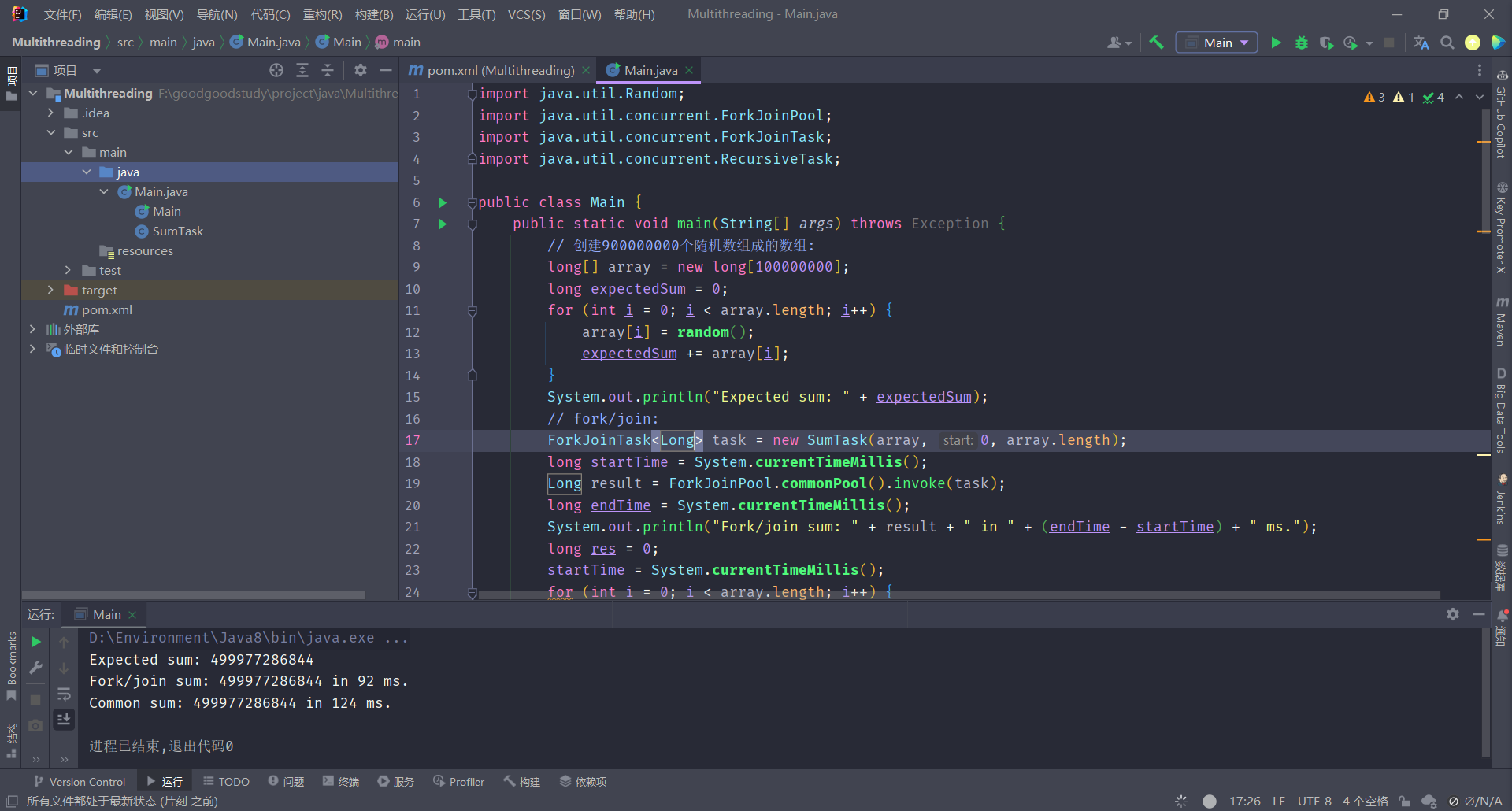
一种基于“分治”的算法:通过分解任务,并行执行,最后合并结果得到最终结果。
写一个不严谨的例子
import java.util.Random;
import java.util.concurrent.ForkJoinPool;
import java.util.concurrent.ForkJoinTask;
import java.util.concurrent.RecursiveTask;

public class Main {
    public static void main(String[] args) throws Exception {
        // 创建900000000个随机数组成的数组:
        long[] array = new long[100000000];
        long expectedSum = 0;
        for (int i = 0; i < array.length; i++) {
            array[i] = random();
            expectedSum += array[i];
        }
        System.out.println("Expected sum: " + expectedSum);
        // fork/join:
        ForkJoinTask<Long> task = new SumTask(array, 0, array.length);
        long startTime = System.currentTimeMillis();
        Long result = ForkJoinPool.commonPool().invoke(task);
        long endTime = System.currentTimeMillis();
        System.out.println("Fork/join sum: " + result + " in " + (endTime - startTime) + " ms.");
        long res = 0;
        startTime = System.currentTimeMillis();
        for (int i = 0; i < array.length; i++) {
            res += array[i];
        }
        endTime = System.currentTimeMillis();
        System.out.println("Common sum: " + res + " in " + (endTime - startTime) + " ms.");
    }

    static Random random = new Random(0);

    static long random() {
        return random.nextInt(10000);
    }
}

class SumTask extends RecursiveTask<Long> {
    static final int THRESHOLD = 500;
    long[] array;
    int start;
    int end;

    SumTask(long[] array, int start, int end) {
        this.array = array;
        this.start = start;
        this.end = end;
    }

    @Override
    protected Long compute() {
        if (end - start <= THRESHOLD) {
            // 如果任务足够小,直接计算:
            long sum = 0;
            for (int i = start; i < end; i++) {
                sum += this.array[i];
                // 故意放慢计算速度:
                //          try {
                //            Thread.sleep(1);
                //        } catch (InterruptedException e) {
                //        }
            }
            return sum;
        }
        // 任务太大,一分为二:
        int middle = (end + start) / 2;
        //System.out.println(String.format("split %d~%d ==> %d~%d, %d~%d", start, end, start, middle, middle, end));
        SumTask subtask1 = new SumTask(this.array, start, middle);
        SumTask subtask2 = new SumTask(this.array, middle, end);
        invokeAll(subtask1, subtask2);
        Long subresult1 = subtask1.join();
        Long subresult2 = subtask2.join();
        Long result = subresult1 + subresult2;
        //System.out.println("result = " + subresult1 + " + " + subresult2 + " ==> " + result);
        return result;
    }
}
ThreadLocal(线程本地变量)
其实就是为了避免冲突在每个线程中都为变量创建了一个副本
使用ThreadLocal要用try ... finally结构,并在finally中清除。
举例如下:
java
import java.util.stream.IntStream;

public class Main {
  public static void main(String[] args) {
    ThreadLocal<String> local = new ThreadLocal<>();
    IntStream.range(0, 10).forEach(i -> new Thread(() -> {
      try {
        local.set(Thread.currentThread().getName() + ":" + i);
        System.out.println("线程:" + Thread.currentThread().getName() + ",local:" + local.get());
      } finally {
        local.remove();
      }
    }).start());
  }
}